
Simulated Juristic Act and Revocation of a GiftDue to the Donee’s Ingratitude通謀虛偽法律行為與因受贈人忘恩負義而撤銷贈與
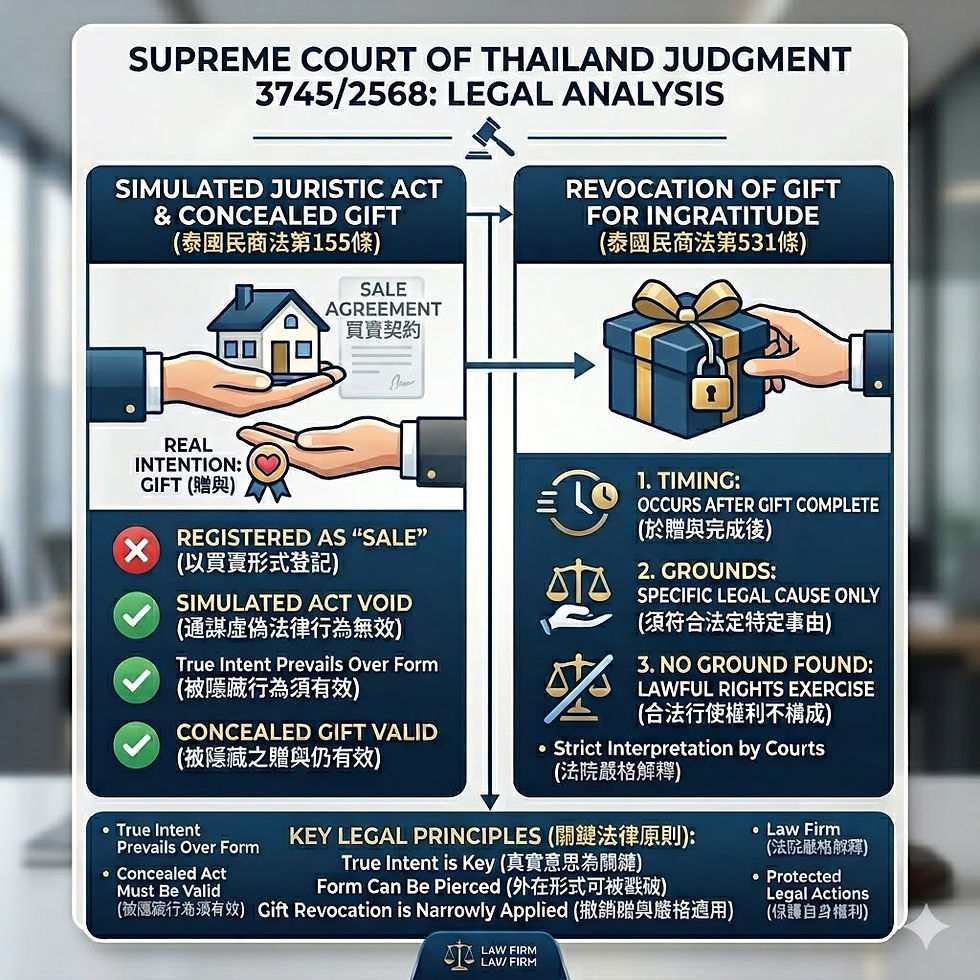
• 《泰國民商法》第155條之通謀虛偽法律行為
• 偽裝為買賣契約的之贈與行為
• 《泰國民商法》第531條關於因受贈人忘恩負義而撤銷贈與之法律要件
最高法院第3745/2568號判決反映《泰國民商法》第155條及第531條有關「通謀虛偽法律行為」及「因受贈人忘恩負義而撤銷贈與」的重要法律原則。本案事實顯示,原告為日本籍人士,與被告保持類似夫妻之關係,並有意基於情感將一戶公寓單位贈與被告。然而,由於原告擔憂其合法配偶產生懷疑,故該所有權移轉其後係以「買賣」而非「贈與」之形式辦理登記。
最高法院認為,雖然該所有權移轉係以買賣契約形式辦理登記,但當事人真正之意思表示實為基於情感之贈與。因此,該買賣行為構成《民商法》第155條第1項所規定之「通謀虛偽法律行為」,該買賣契約因而無效。然而,被隱藏之真正法律行為,即贈與契約,仍得依同條第2項具有法律效力。法院進一步指出,當事人雖以買賣形式於主管機關前辦理所有權移轉登記,然該登記行為已足以符合贈與契約須以書面作成並完成登記之法律要件。因此,該贈與法律行為已依法完成並具有可執行性。
法院另就《民商法》第531條所規定「因受贈人忘恩負義而撤銷贈與」之問題加以審酌。原告主張被告偽造文件並惡意對其提出刑事告訴。然而,法院認為,所主張之文件偽造之行為發生於贈與法律行為完成之前,故不得作為撤銷贈與之事由。至於刑事告訴部分,法院認定被告僅係依法行使權利以保護自身財產,並無惡意誹謗而對原告加以誹謗或重大侮辱之意圖。因此,法院認為被告並未對原告構成忘恩負義,原告亦無權撤銷該贈與。
本判決再次確認一項重要法律原則,即法院將以當事人之「真實意思表示」作為判斷基礎,而非僅依交易之外觀形式認定其法律性質。同時,本案亦顯示,因受贈人忘恩負義而撤銷贈與之規定,法院採取嚴格解釋,並要求贈與人必須證明受贈人於贈與完成後,確實實施法律明文規定之特定行為,方得撤銷贈與。
• 真實意思表示優先於法律行為之外在形式:即使交易以「買賣」形式登記,若事實顯示當事人真正意圖為贈與,法院仍可認定其為通謀虛偽法律行為。
• 通謀虛偽法律行為雖屬無效,但被隱藏之真正法律行為仍可能有效:若被隱藏之法律行為符合所有法定要件,仍可依第155條第2項發生法律效力。
• 撤銷贈與之規定採嚴格解釋:僅於受贈人之行為符合《民商法》第531條所明文規定之情形時,贈與人始得撤銷贈與,且該等行為必須發生於贈與法律行為完成之後
• 合法行使權利通常不構成忘恩負義:若當事人基於合理理由提出告訴或採取法律行動以保護自身權利與財產,通常不構成嚴重誹謗或撤銷贈與之事由。
• Simulated Juristic Acts under Section 155 of the Civil and Commercial Code
• Gifts Disguised as Sale Agreements
• Legal Grounds for Revocation of a Gift Due to the Donee’s Ingratitude under Section 531 of the Civil and Commercial Code
Supreme Court Judgment No. 3745/2568 reflects important legal principles concerning “simulated juristic acts” and the “revocation of a gift due to the donee’s ingratitude” under Sections 155 and 531 of the Thai Civil and Commercial Code. The facts of the case revealed that the plaintiff, a Japanese national, was in a relationship akin to husband and wife with the defendant and intended to transfer ownership of a condominium unit to the defendant as a gift out of affection. However, the ownership transfer was later registered as a “sale” rather than a “gift” because the plaintiff feared that his lawful wife would become suspicious.
The Supreme Court held that although the transfer was registered in the form of a sale agreement, the true intention of the parties was a gift by affection. Therefore, the sale transaction constituted a “simulated juristic act” under Section 155 paragraph one, rendering the sale void. Nevertheless, the concealed juristic act — namely the gift agreement — remained enforceable under Section 155 paragraph two. The Court further held that the registration of ownership transfer before the competent official, even though made under the form of a sale, was sufficient to satisfy the legal requirement for a written and registered gift agreement. Accordingly, the gift transaction was legally complete and enforceable.
The Court also considered the issue of “revocation of a gift due to the donee’s ingratitude” under Section 531. The plaintiff alleged that the defendant had forged documents and maliciously filed criminal complaints against him. However, the Court found that the alleged document forgery occurred before the gift transaction had become complete and therefore could not serve as grounds for revocation of the gift. As for the criminal complaints, the Court determined that the defendant had merely exercised her lawful rights to protect her property and had not acted with malicious intent to defame or seriously insult the plaintiff. Consequently, the Court ruled that the defendant had not committed ingratitude toward the plaintiff, and the plaintiff was not entitled to revoke the gift.
This judgment reaffirms the important legal principle that courts will consider the parties’ “true intention” over the external form of a transaction. It also demonstrates that revocation of a gift on the grounds of ingratitude is interpreted strictly, requiring the donor to prove that the donee committed conduct specifically prescribed by law after the gift had already become legally complete.
• True intention prevails over the form of a juristic act: Even if a transaction is registered as a “sale,” the Court may determine it to be a simulated juristic act if the facts indicate that the parties truly intended a gift.
• A simulated juristic act is void, but the concealed juristic act may remain valid: If the concealed transaction satisfies all legal requirements, it may still be enforceable under Section 155 paragraph two.
• Revocation of a gift is interpreted strictly: A donor may revoke a gift only where the donee’s conduct falls within the circumstances specifically prescribed under Section 531, and such conduct must occur after the gift has become complete.
• Exercising lawful rights does not easily constitute ingratitude: Filing complaints or legal actions to protect one’s rights or property, where reasonably justified, does not amount to serious defamation or grounds for revocation of a gift.


留言